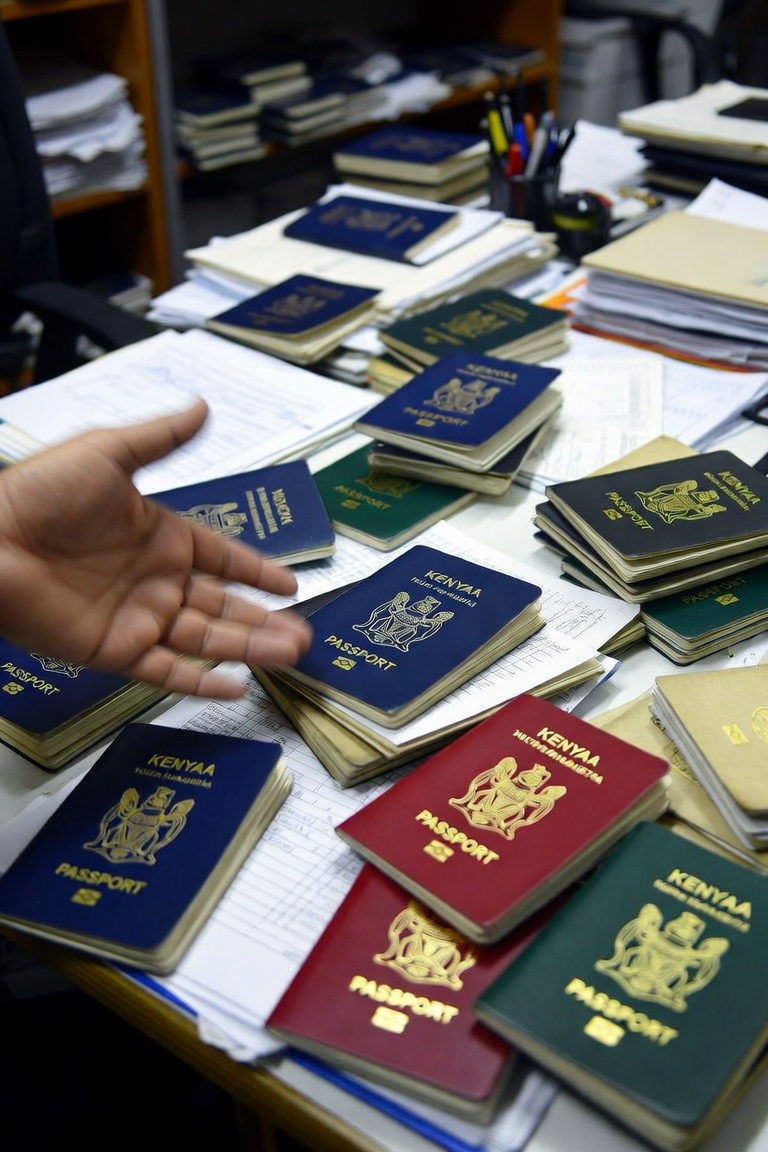
The Kenyan passport pricing chaos — and which booklet you can actually get today
You Paid KSh 12,500 for a Passport and They Handed You a Cheaper Booklet. Where Does the Difference Go?
Kenya's passport booklet options have changed three times in eighteen months. Here's the money trap that survives every single change — and how to protect yourself before you pay.
Every few months the same thing happens at our desk. Someone arrives clutching an eCitizen receipt, genuinely confused, and asks a version of this: "I paid for the big booklet. They gave me a small one. Nobody said anything. So where is my money?"
It is a fair question. It also has an uncomfortable answer, and that answer has been formally documented by a constitutional body — yet almost nobody applying for a passport today knows it.
Let me set out what has actually been happening with Kenyan passport booklets, what the Ombudsman found when it investigated, and the one precaution that costs you nothing but can save you thousands. I'll also be straight with you about which parts of this I can state with confidence and which parts you must check for yourself on the day — because on this particular topic, a lot of what circulates online is out of date within weeks.
First, an honest word about "which booklet is available right now"
I could give you a confident, tidy answer here. I am not going to, and you should be suspicious of any Kenyan blog that does.
Here is the verifiable timeline:
The 34-page ordinary "A" series (KSh 7,500) was withdrawn for new applicants in July 2025, with the government citing operational and supply challenges.
In March 2025, ahead of that, the Ministry of Interior had asked people holding pending 34-page applications to consider upgrading to the 50-page version to speed up processing. Then-Immigration PS Julius Bitok said the country had received 112,700 additional booklets — 92,400 of them 50-page and 20,300 of them 66-page — on top of 50,000 50-page booklets delivered earlier, with issuance prioritised on a first-in-first-out basis.
In early February 2026, the 50-page "B" series (KSh 9,500) disappeared from the eCitizen application flow, leaving the 66-page "C" series at KSh 12,500 as the only standard route for new applicants. That is roughly a 66% jump from the old entry-level fee.
Since then, further reports have circulated suggesting availability has shifted again.
Notice the pattern: the government has repeatedly changed booklet availability without issuing an official public explanation, and reporting has consistently described these as quiet removals rather than announced policy. Sources conflict on the current position, and I am not going to state a "today's price" I cannot stand behind.
So the practical instruction is this: check the live eCitizen portal on the day you apply, and screenshot what you see before you pay. The official eCitizen account portal is the only source that reflects reality in real time. Everything else — including this article — is describing a moving target.
That screenshot instruction is not throwaway advice. It becomes the centre of everything below.
KRA PIN Update+ (New Email)
We provide professional KRA PIN email update services through iTax portal. Fast assistance with emai...
The trap that survives every change
Whichever booklet is on offer this month, one problem has persisted through every single switch since at least 2022. It is this:
You can pay for one booklet and be issued a cheaper one — and there is no automatic refund of the difference.
This is not speculation or a rumour from a WhatsApp group. It is the documented finding of the Commission on Administrative Justice, the body most Kenyans know as the Ombudsman, after a formal investigation into the Department of Immigration presented to the Senate's National Security and Defence Committee.
The Commission found that the department had no mechanism for automatically refunding excess payment where a passport was issued with fewer pages than the applicant had applied and paid for. In the cases examined, complainants had paid for the 50-page series and received the 34-page series, losing the difference to the government with no clear channel of recourse.
The Daily Nation's coverage of the report recorded that all nine allegations investigated were substantiated, with seven complainants confirmed to have paid for the larger booklet and received the smaller one without refund. One applicant was advised by an immigration officer to upgrade because her original series was unavailable — paid the top-up — and was then issued the very series she had upgraded away from, still without a refund.
And here is the detail that matters most, because it demolishes the usual explanation. Immigration reportedly suggested applicants had themselves downgraded on eCitizen. That was directly refuted by the acting Director of Government Digital Payment, who pointed out that the system does not allow an applicant to edit the page count once the application has been submitted.
In other words: the applicant could not have caused it. The downgrade happened downstream, and the money stayed where it was.
Why this is a live risk right now, not a history lesson
You might reasonably think a report from a few years back has been overtaken by events. I would argue the opposite: the conditions that produced it are more present today, not less.
The Ombudsman traced the root causes of delays and series unavailability to two things — delays in approving the procurement of blank passport booklets, and the continuous breakdown of printing machines at Immigration. Those are exactly the pressures that have driven every booklet withdrawal since: the July 2025 removal was attributed to operational and supply challenges, and the February 2026 change was reported as an inventory-management measure to prioritise clearing existing stock.
When a department is juggling stock shortages and prioritising whatever booklets it physically has, the probability that you receive something other than what you paid for goes up, not down. And the refund mechanism the Ombudsman said was missing has not, to public knowledge, been automated since.
Add one more finding to the pile: the Commission also noted that eCitizen could not merge payments made on separate occasions — so if you paid once, then paid a top-up to upgrade, the system could not consolidate them into a single invoice. Anyone who has been asked to "just pay the difference" should understand what that means for their paper trail.
What this costs in real money
The Ombudsman's cases were on an older fee schedule, where the gap between the 34-page and 50-page booklets was KSh 1,500 per applicant — seven confirmed complainants, and those were only the ones who complained.
On the current schedule the gaps are wider. As reported, the ladder has been: 34-page "A" series at KSh 7,500; 50-page "B" series at KSh 9,500; 66-page "C" series at KSh 12,500; diplomatic at around KSh 15,000; and replacement of a lost or mutilated passport at around KSh 20,000. Expedited processing has been reported at a substantially higher figure again.
Do the arithmetic on a forced downgrade at today's numbers. Paying KSh 12,500 and receiving a 34-page booklet is a KSh 5,000 gap. For a first-time applicant chasing a job abroad — someone already paying for medical tests, police clearance, visa fees and an air ticket — KSh 5,000 is not a rounding error. It is a real amount of money disappearing with no receipt for its disappearance.
And crucially: you would have no automatic way of knowing it happened, unless you kept evidence of what you paid for in the first place.
The five minutes that protect you
This is the part I want you to actually act on, because it costs nothing.
Screenshot the portal before you pay. Capture the page showing the booklet series you selected and the fee. Timestamped, on your phone.
Save every payment receipt — both the government copy and the customer copy generated at payment.
If you are asked to top up or upgrade, keep both payment records separately, and do not assume they will appear as one consolidated invoice. The Ombudsman found the system could not merge them.
On collection, check the page count before you leave the counter. Not at home. At the counter, while the officer is still in front of you.
If the series doesn't match what you paid for, say so immediately and in writing, and do not let the paperwork walk away without a record of the discrepancy.
Note step 5 carefully. The Ombudsman's finding was that there is no automatic refund — which means the burden of pursuing it falls entirely on you, and you cannot pursue what you cannot evidence. Applicants who kept nothing had nothing to argue with.
There is also a genuine dilemma here that deserves honesty rather than slogans. If you are travelling in three weeks and they hand you a smaller booklet than you paid for, refusing it may cost you your trip. Most people accept the passport — which is entirely rational. Accepting it does not extinguish your claim to the difference. But it does mean you have to go and get it, deliberately, with documents in hand.
Where we come in
I am not going to pretend the passport application form itself is impossible. Plenty of people complete it unaided, and good.
What sends people to our desk is everything around it: an eCitizen account tied to a phone number they lost two years ago; a first-time applicant unsure which supporting documents actually get accepted; a rejected application with no clear reason given; a booklet mismatch and no idea who to write to or what to include. These are not "fill the form" problems — they are navigation problems, and navigating government portals is our daily work. You can see the full range of what we handle on our government services page.
If your passport application is one piece of a bigger errand — Huduma services, certificates, clearances — our guide on accessing Huduma services online is a useful companion, and our overview of what online cyber services actually mean for Kenyans explains how we approach this work generally.
The honest summary is this: the passport process rewards people who document everything and punishes people who trust the system to look after them. If you would rather have someone who knows the terrain handle it — and keep the paper trail properly the first time — that is exactly what we are for.
Frequently asked questions
How much does a Kenyan passport cost in 2026? Reported fees have been KSh 7,500 for the 34-page "A" series, KSh 9,500 for the 50-page "B" series, KSh 12,500 for the 66-page "C" series, around KSh 15,000 for diplomatic and around KSh 20,000 for replacing a lost or mutilated passport. Because booklet availability has changed repeatedly without official announcement, confirm the current fee on the eCitizen portal on the day you apply.
Why can't I select the cheaper passport booklet on eCitizen? Options have been withdrawn at different points — the 34-page in July 2025 and the 50-page in early February 2026 — with the government citing operational, supply and inventory reasons. At times the form still displayed removed options while the flow defaulted to a different booklet.
Can I get a refund if I'm issued a passport with fewer pages than I paid for? The Ombudsman found the Department of Immigration has no mechanism for automatic refunds in this situation. Any claim must be actively pursued by you, which is why keeping your payment receipts and a screenshot of your original selection matters.
Did applicants downgrade their own applications? The acting Director of Government Digital Payment refuted that explanation, noting the system does not allow an applicant to edit the page count after submission.
Why do passport delays and booklet shortages keep happening? The Ombudsman attributed them primarily to delays in approving procurement of blank booklets and repeated breakdowns of printing machines at Immigration.
What should I do before paying for a passport? Screenshot the portal page showing your selected series and fee, save both payment receipts, and check the page count at the collection counter before you leave.
SHA Registration
We provide professional SHA registration services through the Social Health Authority portal. Expert...
Booklet availability keeps moving, but the money trap doesn't. If you want your passport application handled properly — correct documents, clean paper trail, and someone to push back if the booklet you receive isn't the one you paid for — talk to the Cyber Mfukoni desk and let us take it from here.
About the author
Julius
IT & E-Government Services Specialist
Julius is a Nairobi-based IT specialist with over a decade of hands-on experience navigating Kenya's digital government platforms — eCitizen, NTSA TIMS, KRA iTax, and the Business Registration Service (BRS). He has helped thousands of individuals and businesses cut through the paperwork to access government services online and writes practical, step-by-step guides drawn from that day-to-day experience.
Related Agency
DIS - Directorate of Immigration Services
DIS
We provide professional online immigration services including passport applications, e-visa processing, work permits, dual citizenship, and alien card registration. Fast, reliable assistance for all your immigration needs.
View Agency ServicesRelated Services
Need Expert Assistance?
Our team can handle the entire application process for you.